Chapter one — the whole life at a glance
About
Kalpana Datta
Eighty-one years, four names, two countries and one of the most closely documented revolutionary cases in colonial Bengal. This page is the whole arc in one place; the chapters that follow take each part slowly.
Kalpana Datta · Kalpana Dutt · Kalpana Joshi
Who was Kalpana Datta?
She was born on 27 July 1913 at Sripur, a village in the Chittagong district of what was then the Bengal Presidency and is today Boalkhali in Bangladesh. Her father, Binod Behari Dattagupta, was a government employee, which placed the family in exactly the salaried, educated stratum from which the colonial administration expected loyalty and from which, repeatedly, it got the opposite.
She matriculated in 1929 and went to Calcutta to study science at Bethune College, an institution whose roots reach back to the Bethune School founded in 1849 and one of the earliest routes to higher education for women in India. There she joined the Chhatri Sangha, a women students' association described in reference works as semi-revolutionary. Pritilata Waddedar and Bina Das moved in the same circle.
In May 1931 she joined the group Surya Sen had built in Chittagong — the Indian Republican Army, Chittagong Branch — about a year after its armoury raid of 18 April 1930. Accounts of her work describe carrying explosive material from Calcutta, preparing gun-cotton, and training with a revolver alongside Pritilata Waddedar.
In September 1932 she was arrested in male attire while scouting the Pahartali European Club ahead of a planned attack, roughly a week before it took place. Released on bail for want of evidence, she went underground. She was arrested again on 19 May 1933, tried in a second supplementary hearing of the Chittagong Armoury Raid case, and sentenced to transportation for life.
She was released in 1939. She graduated from the University of Calcutta in 1940, joined the Communist Party of India, organised among peasants and women, married P. C. Joshi in 1943, worked through the Bengal famine and Partition, stood unsuccessfully for the Bengal Legislative Assembly in 1946, wrote a memoir of the Chittagong revolutionaries, and worked for years at the Indian Statistical Institute. She died on 8 February 1995.
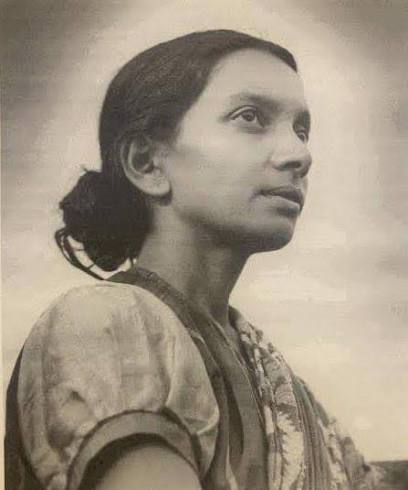
Four names for one person, and each of them marks a stage of her life.
- Kalpana Dattagupta The family surname recorded for her father, Binod Behari Dattagupta.
- Kalpana Datta The form under which she is most often catalogued, and the one used throughout this archive.
- Kalpana Dutt The alternative transliteration from Bengali; it appears on the English edition of her memoir and in much of the historiography.
- Kalpana Joshi Her name after her 1943 marriage to P. C. Joshi. Searching under this name surfaces the later political and institutional half of her life.
A life across different eras
She lived through five different Indias.
Each of these periods asked something different of her, and in each she was doing a recognisably different kind of work. Setting them side by side makes one thing hard to miss: the years everyone remembers are the shortest column on the page.
-
1913 – 1930
Colonial India, from inside a schoolroom
A district town childhood in a province where politics had already entered the classroom. She is a pupil, then a matriculate, then a science student. Nothing in the record marks her out yet.
-
1931 – 1933
Revolutionary resistance
Two and a half years of clandestine work: couriering explosives, chemistry, reconnaissance, disguise and flight. This is the fraction of her life that almost every retelling is built from.
-
1933 – 1939
Imprisonment
Six years under a sentence of transportation for life, during a period when the treatment of political prisoners in Bengal was itself a public controversy.
-
1939 – 1947
Late colonial transformation
A degree completed at twenty-seven, party membership, organising work, a marriage, an election contest, a famine, a memoir, and the partition of the province she was born in.
-
1947 – 1995
Post-independence India
Nearly five decades of ordinary working life, including years at the Indian Statistical Institute. The least dramatic and by far the longest part of her story.
Why her story matters
Four reasons to keep one life in focus.
-
01
Women's visibility in history is not automatic
Between 1930 and 1933 a whole cohort of women in Bengal moved into armed political organisation. Public memory has largely kept two or three of their names. That is not because the others did less; it is because the work of remembering was done unevenly, and mostly by people who did not think to look.
-
02
Popular memory keeps a very short list
India's freedom struggle involved millions of people across six decades and dozens of political traditions. Most public retellings compress it into a handful of famous figures. Following a single documented life through its whole length is one of the few reliable correctives.
-
03
She left testimony, and testimony is evidence
Kalpana Datta wrote her own account of the Chittagong revolutionaries. A participant memoir is not neutral — no memoir is — but it is a primary source with a name attached, and it can be read against police records, trial documents and other participants' accounts. That is a different order of evidence from a dramatisation.
-
04
The second half of a life is still the life
She spent roughly two and a half years as an active revolutionary and more than fifty as a graduate, organiser, relief worker, writer, mother and employee. Treating only the first as her story is a choice, and it is worth noticing that it is one.
This section states an argument about historical memory. It is offered as interpretation, not as documented fact, and is kept separate from the dated record above for that reason.
How this archive is written
What is claimed here, and what is not.
This site does
- Give dates only where reference sources agree, and say so when they do not.
- Distinguish what Kalpana Datta did from what happened around her.
- Name the limits of the photographic record instead of inventing captions.
- Separate interpretation from documented fact.
This site does not
- Attribute quotations, letters or speeches to her that are not in the record.
- Claim she took part in the raid of 18 April 1930, which predates her joining.
- Assign her awards, offices or achievements that cannot be verified.
- Present a screen portrayal as though it were evidence.
Found an error, or a better source? Tell us — corrections are the point.