The photographic record
Gallery
& Archives
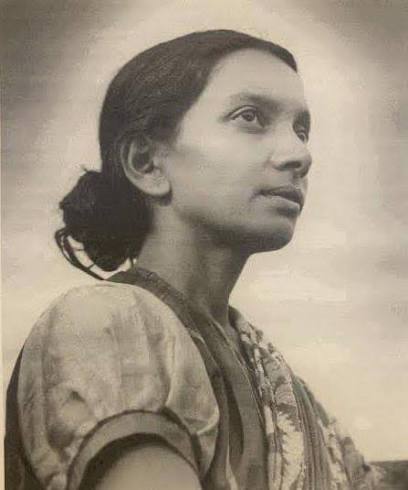
Five photographs. That is the entire visual record this archive holds of a woman who lived eighty-one years. Every one is shown whole, at its true proportions, with nothing cropped away and no caption invented to fill the silence around it.
- Images held
- 5
- With a recorded date
- 0
- With a named photographer
- 0
Group by how the image survives
These groups describe the photographs, not their dates. None of the five carries a recorded year, so grouping them chronologically would mean guessing, and this archive does not guess about images.
Kalpana Datta, outdoors. A three-quarter portrait in a patterned sari, taken against open sky. One of the most widely reproduced images of her.
Close portrait. The most detailed image in the collection and the only one in landscape proportion. It appears frequently in accounts of the Chittagong movement.
Printed halftone, young. The visible dot pattern shows this survives as a reproduction from a printed page rather than from a photographic print. The original publication is unidentified.
Against sky and field. A softer, higher-contrast print in which the landscape behind her is legible. The setting is not identified in any source available to this archive.
Later life. The only image in the collection showing her beyond youth, and the only one that speaks to the fifty-six years after 1939. It survives as a coarse newspaper-grade halftone.
About this collection
Why so few pictures, and why none of them is dated.
Photographs of Indian revolutionaries from this period survive unevenly. Some were taken by police as part of a case file. Some were family portraits that a household kept and a newspaper later borrowed. Most were reproduced repeatedly in print, losing detail with each pass, until the version that circulates today is several generations away from the negative.
Two of the five images here are visibly printed halftones. Their dot pattern is the fingerprint of a newspaper or book page. Nothing in the sources available to this archive names when they were taken, where, or by whom.
This archive therefore states what it can see and stops. A caption reading “Kalpana Datta at Bethune College, 1930” would be more satisfying and would very likely be false. Once a false caption is published it gets copied, and after enough copies it becomes what everyone knows.
If you hold a dated print, a publication reference, an archival accession number or any provenance for any of these images, that information would be genuinely valuable. Please get in touch.
How images are handled on this site
- No photograph is cropped. Every image is displayed at its own proportions.
- No face is cut off at any screen width, on any page.
- No image is stretched, squashed or upscaled beyond its native resolution.
- Every image carries descriptive alternative text for screen readers.
- No caption asserts a date, place or photographer that a source does not give.