Kalpana Datta 1913 — 1995

Chapter 02 — Chittagong, 1930

18 April 1930

The Chittagong Revolution

For four days in April 1930, a group of about sixty-five people attempted to detach an entire district from British administration. They were led by a schoolteacher. Most of them were very young. The plan failed on its own terms and changed the political weather of eastern Bengal for the next decade.

Kalpana Datta was seventeen at the time of the raid and was studying in Calcutta. She joined the organisation that carried it out in May 1931, roughly a year later. This chapter sets out the events first, and her place in them second, because that is the order in which they happened.

What was attempted

Not a raid on one building. A coordinated attempt to switch off a district.

The organisation called itself the Indian Republican Army, Chittagong Branch. Its plan treated colonial control as an infrastructure problem: take the weapons, cut the wires, stop the trains, and hold the resulting silence for as long as possible.

  1. 01

    The police armoury

    Taken by a party led by Ganesh Ghosh. Accounts describe the raiders assembling here, raising the national flag and proclaiming a provisional revolutionary government.

  2. 02

    The Auxiliary Force armoury

    Taken by Lokenath Bal with a party of about ten. The armouries yielded weapons but not the ammunition the plan depended on — the single failure that decided everything afterwards.

  3. 03

    Telegraph and telephone lines

    Cut, isolating Chittagong from the rest of the province. Communications were as much a target as weapons; without them the administration could not call for help.

  4. 04

    The railway

    Train movement was disrupted to slow the arrival of troops. The combination of severed wires and stopped trains was intended to buy days, not hours.

  5. 05

    The European Club at Pahartali

    A party of about sixteen went to the club. It was Good Friday, and few members were present. The club would return to this story two and a half years later, under different circumstances.

22 April 1930

The Jalalabad hills

Four days after the raid, British troops surrounded the revolutionaries in the Jalalabad hills outside Chittagong. Twelve revolutionaries were killed. The figure most often cited for troop losses is over eighty. The survivors dispersed, and the movement's second phase — years of dispersal, hiding and individual actions — began here.

Casualty figures for this engagement differ between accounts. The numbers given follow the most widely reproduced record and should be read as approximate.

Date of the raid
18 April 1930, about 22:00
Participants
Approximately 65
Jalalabad hills
22 April 1930
Judgment in the main trial
1 March 1932
Surya Sen arrested
16 February 1933
Surya Sen executed
12 January 1934

The people behind the movement

Four names, and what the record actually says about each.

Only people whose connection to this history is documented in reference sources appear here, and each entry stops where the sources stop.

1894 – 1934

Surya Sen

Schoolteacher. Leader of the organisation.

Known to his students as Masterda. He led the planning and execution of the raid of 18 April 1930 and held the remnants of the organisation together through nearly three years of pursuit.

He was arrested on 16 February 1933 after being betrayed by a relative, Netra Sen, and was hanged on 12 January 1934 alongside Tarakeswar Dastidar. Accounts record that both men were tortured before execution.

1911 – 1932

Pritilata Waddedar

Philosophy graduate. Led the Pahartali operation.

Born at Dhalghat in the Chittagong district. She studied at Dr Khastagir Government Girls' High School, at Eden College in Dhaka, and took her degree in philosophy at Bethune College in Calcutta — a degree the university withheld and finally conferred in 2012, eighty years after her death. She was working as a school headmistress in Chittagong.

She led the armed attack on the Pahartali European Club on 24 September 1932 and took potassium cyanide after being wounded rather than be captured. She was twenty-one.

1913 – 1995

Kalpana Datta

Science student. Courier, chemist, fugitive.

She joined the organisation in May 1931, about a year after the raid. Reference accounts of her work describe carrying explosive material from Calcutta, secretly preparing gun-cotton, and training in revolver shooting with Pritilata Waddedar.

Arrested in September 1932 while scouting the European Club in male attire; released on bail; went underground; arrested again on 19 May 1933 and sentenced to transportation for life.

What happened next

1911 – 1986

Bina Das

Student. Acted alone, in public, in daylight.

Born at Krishnanagar in Bengal and a member of the Chhatri Sangha in Calcutta. On 6 February 1932, at the University of Calcutta convocation, she fired five shots at Stanley Jackson, the Governor of Bengal. None struck him.

She was sentenced to nine years' rigorous imprisonment and released in April 1939. Her connection to the Chittagong group is through the same Calcutta student network rather than through the raid itself.

Around sixty-five people took part in the raid of 18 April 1930, and many more were tried, imprisoned or killed in the years that followed. The four entries above are the individuals whose lives intersect directly with the subject of this archive; they are not a roll of honour and are not intended as one.

Women and revolutionary resistance

In 1930 a woman in Bengal could be tried for waging war against the King before she could vote for the government that tried her.

The revolutionary organisations of Bengal did not begin as places where women were welcome. Admission was argued over, resisted, and in most groups conceded late and partially. When women were finally given operational roles, the reasoning was frequently practical rather than principled: a woman drew less suspicion at a checkpoint, could carry material past a search, and could visit a prisoner as a relative.

What that practical reasoning underestimated was the consequence. Once women were doing the work, they were also doing the leading, the training and the dying, and the state's response made no distinction. Pritilata Waddedar commanded an armed operation. Kalpana Datta was sentenced to transportation for life. Bina Das received nine years.

The social cost sat outside the courtroom. A young woman who joined this work risked her family's standing, her marriage prospects, her education and her reputation in a society that had no available category for what she was doing. The men she worked alongside risked their lives; she risked her life and her name.

It is also worth resisting the opposite simplification. These women were not identical, did not agree with one another about everything, and made different choices under pressure. Treating them as a single symbolic figure — the woman revolutionary — erases exactly the individuality that makes their decisions legible.

This section interprets the documented record rather than reporting it. The dates, sentences and events referred to are given with sources on the Books & Further Reading page.

The European Club operation

September 1932: the week that decided which of two women led an attack.

The Pahartali European Club had been a target since 1930. Accounts of the period record a signboard at such clubs restricting entry — the reason it was chosen was as much symbolic as tactical.

Surya Sen assigned the operation to Pritilata Waddedar and Kalpana Datta. In the days before it, Kalpana Datta went to survey the area. Accounts record that she did so dressed in male attire, that this aroused the suspicion of the police, and that she was arrested roughly a week before the planned date. She was released for want of evidence linking her to the organisation, and went underground rather than return to Calcutta.

Because of that arrest, leadership of the operation passed to Pritilata Waddedar alone. It was carried out on the night of 24 September 1932. She was wounded, and took potassium cyanide rather than be taken alive.

A note on how this is told

This episode is often retold as a near miss — the arrest that saved one life and cost another. The framing is understandable and it is not what the sources say. They record a sequence: an assignment to two people, an arrest of one, a reassignment, an attack, a death. Everything beyond that sequence — what either woman felt, intended or would have done — is not documented, and this archive does not supply it.
Aftermath

The courts took longer than the fighting, and did more lasting damage.

  1. 1 March 1932

    Judgment in the main trial

    The principal Chittagong Armoury Raid trial concluded in January 1932 and judgment was delivered on 1 March. Twelve defendants were sentenced to deportation for life to the Andaman Islands, two received three-year sentences, and thirty-two were acquitted.

  2. 16 February 1933

    Surya Sen is arrested

    He was taken while sheltering in the house of a family member, after being informed on by a relative, Netra Sen. Netra Sen was killed by revolutionaries before any reward reached him.

  3. 19 May 1933

    Kalpana Datta is arrested

    Her second arrest ended roughly eight months underground. She was tried in a second supplementary hearing of the armoury raid case and sentenced to transportation for life.

  4. 12 January 1934

    Executions

    Surya Sen and Tarakeswar Dastidar were hanged. With the leadership dead or imprisoned, the Chittagong organisation as an operating body came to an end; the case it generated continued through the courts for years afterwards.

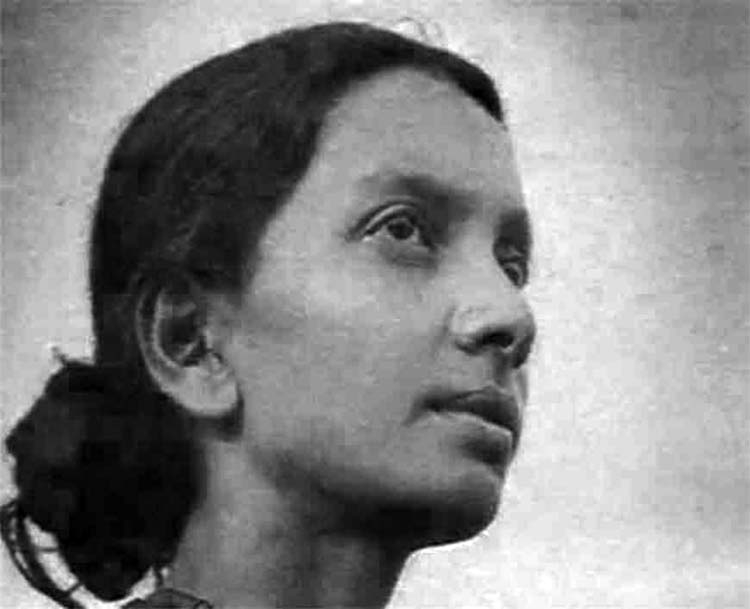
Archival photograph of a young Kalpana Datta in three-quarter profile, looking upward and to her right against a plain background.
Kalpana Datta. Archival photograph, widely reproduced in accounts of the Chittagong movement. The date and photographer are not recorded in the source available to this archive.

Where she stands in this history

She is not a raider of 18 April 1930, and calling her one makes her achievement smaller, not larger.

Popular summaries frequently list Kalpana Datta among the participants in the armoury raid. The dates do not allow it: the raid was in April 1930 and the sources record that she joined the organisation in May 1931. The confusion is easy to explain — she was tried and sentenced under the armoury raid case, which is where her name enters the official record.

The correction matters because what she actually did is more interesting than the version that gets repeated. She joined an organisation that was already broken, already hunted, and already losing. She did so knowing what had happened at Jalalabad and knowing what the courts had done in the main trial. She then carried explosives, made gun-cotton, scouted a target, and spent months as a fugitive.

Joining a movement at its height is one kind of decision. Joining it after its defeat is a different one.